


Japan Town Saigon: Where It Is, What to Eat, When to Go
29/08/2024Japan Town is considered a miniature version of Japan right in the heart of Ho Chi Minh City. Spanning less than 2km, it consists of alleys intersecting between the bustling streets of Le Thanh Ton and Thai Van Lung.
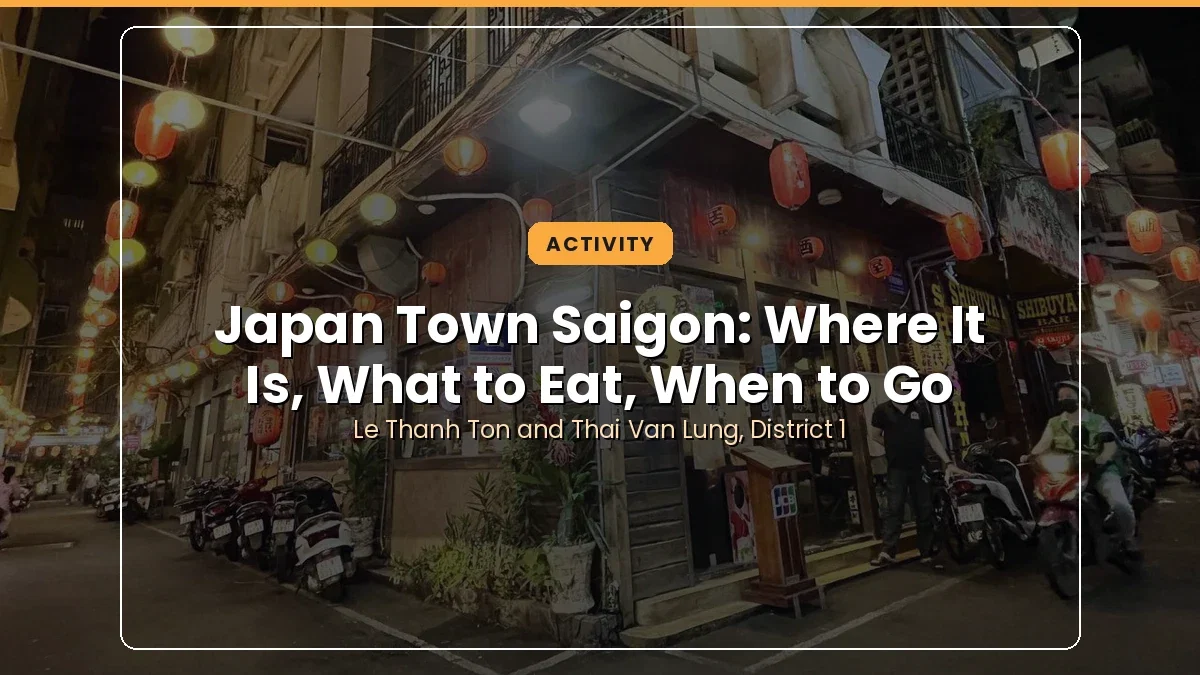
Japan Town in Saigon sits around Le Thanh Ton and Thai Van Lung in District 1, along with the small lanes running between them. There is no gate and no shared opening time. It is a cluster of several dozen Japanese restaurants packed into a few blocks, so the way to use it is to choose the restaurant first and work backwards to the walk and the departure time.
- Where: the Le Thanh Ton and Thai Van Lung junction, District 1, a short walk from the Opera House.
- Busiest: 6pm to 9pm on weekday evenings.
- Not the same as the Japanese dining area around Pham Viet Chanh, about 3 km away. Booking in the wrong one is the most common mistake.
- Lane addresses look like 8A/11B1. The part after the slash is the house number inside the lane.
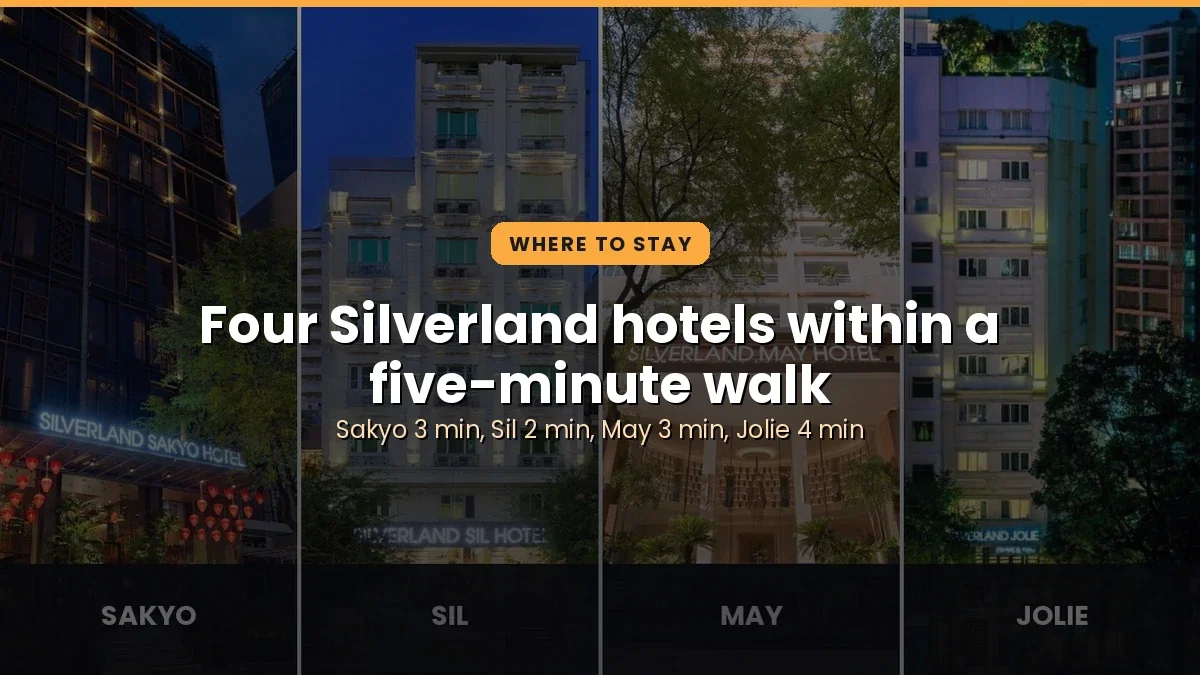
- Four Silverland hotels sit within 400 m: Sakyo, Sil, May and Jolie.
Table of Contents
Where Japan Town Saigon actually is
Use the Le Thanh Ton and Thai Van Lung junction as your anchor. From there the dining area spreads out in every direction for about 300 m. The two lane clusters worth remembering are the entrances at 15 and 15B Le Thanh Ton, and the lanes at 8 and 8A Thai Van Lung. That is where the izakaya, noodle shops and small sushi counters are concentrated.
The street frontage on Le Thanh Ton and Thai Van Lung holds the larger restaurants and a few bars. Inside the lanes the venues are small, many with just a counter and around ten seats.
One thing to get right before you book: Saigon has two Japanese dining areas. The second is around Pham Viet Chanh, roughly 3 km from Le Thanh Ton. Both come up when you search for Japan Town Saigon. Reserving a table in one and walking around the other is the surest way to miss your booking.
How to read a lane address
This is where visitors get lost, and it is the part most guides skip.
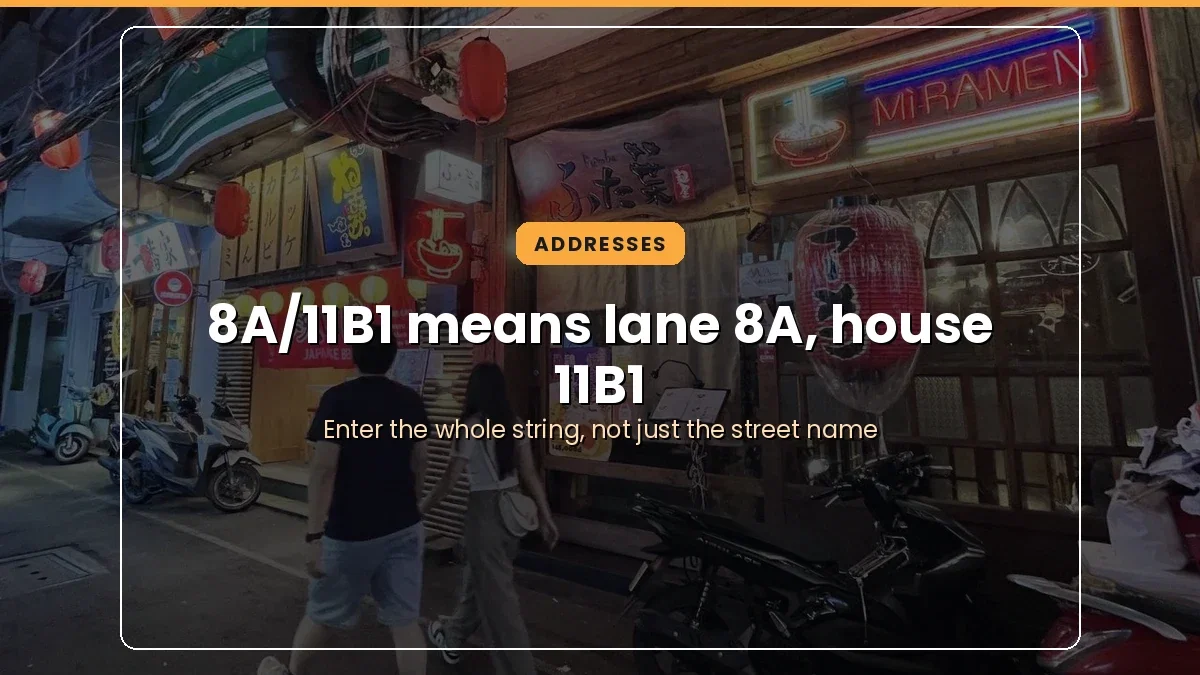
An address like 8A/11B1 Thai Van Lung has two parts. 8A is the lane entrance on Thai Van Lung itself. 11B1 is the house number inside that lane. Enter the whole string into a map app and you reach the restaurant. Enter only “Thai Van Lung” or only “8A” and you reach the lane entrance, while the restaurant may be another 50 m in and up a flight of stairs.
A practical habit: when you book, copy the restaurant’s address exactly as they give it and do not shorten it. When ordering a car, paste that full string into the destination field rather than typing the restaurant name, because names repeat across branches.
A real example of the branch problem. One well-known ramen chain has a branch in this area, and listings currently disagree on its address: several platforms give a Le Thanh Ton number, while older posts from the brand itself give a Thai Van Lung one. The two are a walk apart. This is why you should take the address from the restaurant when you book, not from the first search result.
When to go
The district has no shared hours, so the real question is your chosen restaurant’s hours. That said, the rhythm of the area is predictable:
| Window | Good for | Watch out for |
|---|---|---|
| 11am to 2pm | A quick lunch, a bowl of noodles or a set menu | Not every venue opens for lunch. Many izakaya open only in the evening. |
| 5pm to 6pm | An early sit-down, easy to get a table without booking | The easiest window for solo diners and couples. |
| 6pm to 9pm | The main dinner service, and the liveliest atmosphere | The busiest window. Book ahead for the small lane venues. |
| After 9pm | Drinks and a light plate after dinner | Ask separately about the kitchen’s last order, usually earlier than closing. |
Two things to ask separately when you call: what time the restaurant closes, and what time the kitchen takes its last order. These are different, usually 30 to 60 minutes apart. A delivery app’s cut-off time tells you nothing about dine-in hours.
Sunday needs the most checking. Some Japanese venues here close on Sunday, following the habit of their parent restaurants in Japan. If your trip has one free evening and it falls on a Sunday, lock the restaurant in the day before.
What to eat: pick the format, then the restaurant
We would settle the format of the meal first. The three below differ in how long they take, how you order and how the bill adds up, so this choice shapes the evening more than the choice of venue.
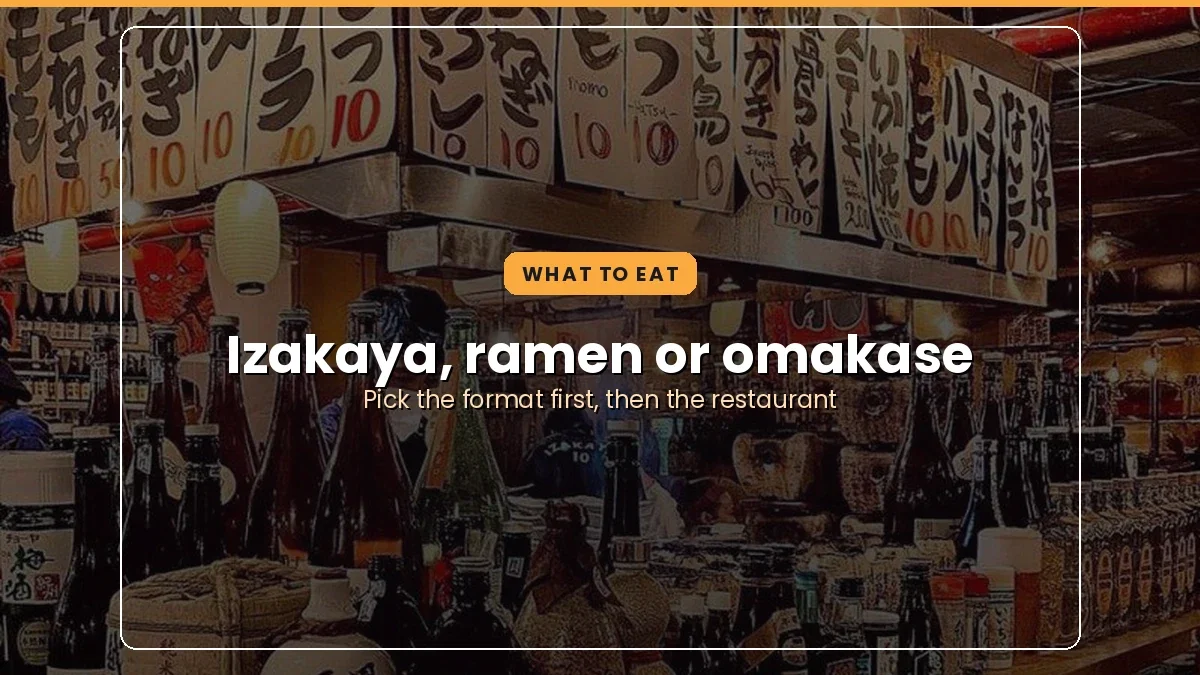
Izakaya: shared plates, a long sit
Lots of small dishes to share, usually grilled skewers, fried items, salads and drinks. Good for groups of two to six, and good for an evening with nothing scheduled after. The bill accumulates dish by dish, so it climbs past expectations if you keep ordering through the night.
Ramen and tsukemen: fast and easy to budget
One bowl is the meal. Good for solo diners, good for a first dinner after a flight, and good when you still have work afterwards. Toppings add directly to the bowl price, so you know the total before you order. Udon is not a given at a ramen shop, so check the menu.
Sushi and omakase: a meal with a fixed start time
Omakase is a chef-decided menu served as a seating at a set time. It needs a booking, it needs you to arrive on time, and it usually runs 90 minutes or more. This is not a meal to squeeze between two appointments. When you book, settle four things at once: what the course includes, how long it runs, the cancellation terms, and whether dietary restrictions can be handled.
Working out a dinner budget for two
The figures below are our own planning estimates, not any restaurant’s published prices. Confirm actual prices when you book.
| Format | A typical order for two | Relative cost |
|---|---|---|
| Ramen | Two bowls, one plate of gyoza, two drinks | Lowest of the three, and the easiest to predict |
| Izakaya | Six to eight small shared plates, four drinks | Roughly two to three times a ramen dinner |
| Omakase | Two seatings, drinks not included | The highest, typically several times either of the above |
Three things push a bill well past the estimate: drinks, service charge and tax. Before the first order, ask whether menu prices already include tax and service. With a larger group, agree up front which dishes are shared and which are individual, since drinks are what usually skews the split at the end.
Two sample evenings
Two hours: dinner and back
A 6pm to 8pm window. Leave the hotel at 5.50pm with the restaurant address saved, go straight there, eat in one venue, and walk back the way you came.
This suits a first evening after a flight, or the night before a working day. The important part is not switching venues halfway. Every change means another hunt for a lane entrance, another menu and another bill, which spends exactly the time a short evening is meant to protect.
Four hours: a walk, dinner, then a separate drink
A 5pm to 9pm window. Start with 30 minutes walking Le Thanh Ton and Thai Van Lung to see what the venues look like, sit down to dinner at 6pm, then give the last part of the evening to a separate bar.
We would pick either omakase or izakaya, not both in one night. If conversation is the point, spend longer at the main meal. If exploring is the point, keep dinner simple and give the walking more of the evening.
Walking to Japan Town from Silverland hotels
Four Silverland properties sit inside or right beside Japan Town. The distances below were measured on Google Maps on 13 October 2026, from each hotel door to the two main lane clusters.
| Hotel | To the Le Thanh Ton lanes | To the Thai Van Lung lanes |
|---|---|---|
| Silverland Sakyo, 10A-10B-10C Le Thanh Ton | 190 m, about 3 minutes | 400 m, about 5 minutes |
| Silverland Sil, 20-22-24 Thai Van Lung | about 5 minutes | 160 m, about 2 minutes |
| Silverland May, 28-30 Thi Sach | 190 m, about 3 minutes | 220 m, about 3 minutes |
| Silverland Jolie, 4D Thi Sach | about 5 minutes | 300 m, about 4 minutes |
In short, all four are within a five-minute walk of the dining area. Silverland Sil is closest to the Thai Van Lung lanes at 160 m. Silverland Sakyo is closest to the Le Thanh Ton lanes and is also the property with Japanese-inspired design, which suits guests who want the stay and the dinner to feel like one piece.
Browse the Silverland hotels to pick the property that matches how you want your evenings to run.
Practical notes
Book with the full details. Give the restaurant your party size, arrival time and any dietary restrictions. A booking message is not a held table until they reply to confirm. At counter-only venues, also ask whether your group can sit together.
Eating alone needs no plan. Pick the dish you want, ask if there is a seat, and save the restaurant pin for the walk back. Counter seats suit solo diners, but a small venue does not automatically have one free.
Ask about payment before ordering. Carry both a card and some Vietnamese dong. A card logo on an old listing is no guarantee that your particular foreign-issued card will work at that venue.
Vegetarian and halal need specific questions. A vegetable dish does not mean a vegetarian kitchen. Ask directly about stock, sauces and frying oil. For halal, ask about current certification and preparation, because Japanese branding and a seafood menu establish neither.
Getting back at night. Save your hotel’s full address including the street number. Step into a doorway to check your phone rather than standing at the kerb. If you are tired, book a car; the distances here are short enough that the fare is minor.
Frequently asked questions
Where is Japan Town in Ho Chi Minh City?
Around the Le Thanh Ton and Thai Van Lung junction in District 1, plus the lanes connecting the two streets. The two main lane clusters are at 15 and 15B Le Thanh Ton, and 8 and 8A Thai Van Lung.
What time does Japan Town open?
There is no shared opening time, because this is a cluster of restaurants rather than a gated district. The hours that matter are your chosen restaurant’s. The general rhythm: lunch from 11am, with the busiest dinner period from 6pm to 9pm.
Do I need a reservation?
Book for omakase and for any meal with something scheduled after it. Small lane venues are also worth booking for groups of three or more. A bowl of ramen at 5pm usually needs no booking.
Is this the same as the Pham Viet Chanh Japanese area?
No, and they are about 3 km apart. Both appear in searches for Japan Town Saigon. Check the street name in the restaurant’s address before booking a table or a car.
Is Japan Town good for solo dining?
Yes. A bowl of ramen or a counter seat makes a straightforward meal for one. Ask about counter availability when booking, since a small venue does not automatically have a free seat.
What does an address like 8A/11B1 mean?
8A is the lane entrance on the street, and 11B1 is the house number inside that lane. Enter the whole string in your map app or the destination field when booking a car. Entering only the street name stops you at the lane entrance.
How much should we budget for dinner?
Budget from how you plan to order rather than from a single figure. A bowl of ramen is the easiest to predict; an izakaya bill accumulates by dish and typically runs two to three times higher; omakase is a fixed seating and considerably more. Ask whether prices include tax and service.
Are there vegetarian or halal options?
Ask each restaurant directly about ingredients and preparation. A vegetable dish on the menu does not confirm a vegetarian kitchen, and Japanese branding does not confirm halal standards.
How far is Japan Town from the Silverland hotels?
Silverland Sil is 2 minutes from the Thai Van Lung lanes, Silverland Sakyo 3 minutes from the Le Thanh Ton lanes, Silverland May 3 minutes from both, and Silverland Jolie 4 minutes. Measured on Google Maps on 13 October 2026.
Is it safe to walk back late?
Use a lit, busy route, keep your belongings close, and avoid checking your phone at the edge of the road. If the route feels uncomfortable or you are tired, book a car to the hotel’s exact address. Distances within the area are short, so the fare is minor.
Last updated: 13 October 2026.
What else?
What’s Around Silverland Yen: A Walking Guide to District 1’s Museum Quarter
Silverland Yen stands at 73-75 Thu Khoa Huan Street, on a short block in Ben Thanh Ward. Guests book it...
A Slow Day Near Silverland Jolie: From Thi Sach Street to the Saigon River
Thi Sach is a short street, and if you walk straight down it from Silverland Jolie you arrive at the...
What’s Around Silverland Ben Thanh: A Walking Guide to the Market, Le Loi and Beyond
The fresh-food section of the market opens at four in the morning, and the bookshop on Le Loi stays open...